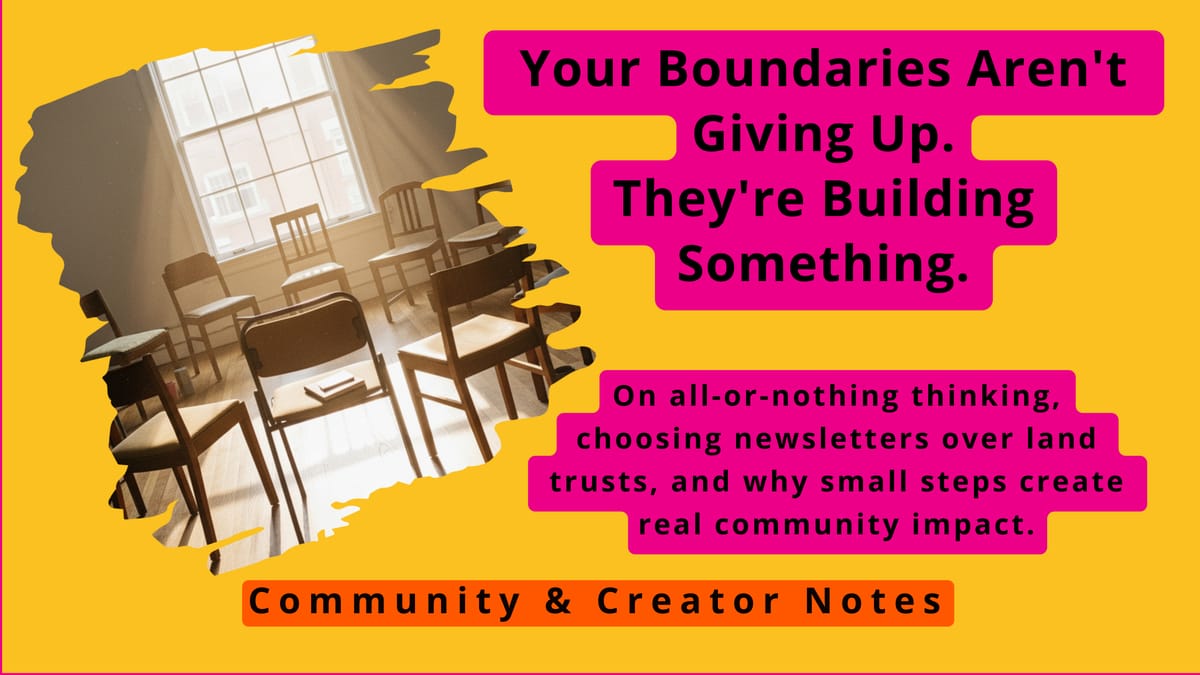
Your Boundaries Aren't Giving Up. They're Building Something.
On all-or-nothing thinking, choosing newsletters over land trusts, and why small steps create real community impact
11:47 PM. Phone glowing blue in the dark. Your thumb hovers over Instagram, knowing you should put it down, knowing you need sleep.
But there’s this voice: “You’ve wasted the whole evening. At least scroll for something useful.” So you do. And twenty minutes later, you’re watching someone’s morning routine in Bali while your brain buzzes with cortisol and your sleep gets pushed to tomorrow’s problem.
You know what you need. You’ve always known. But somehow, protecting yourself feels like admitting defeat.
Here’s what I’ve learned after removing social media and email from my phone in August: the biggest barrier to self-care isn’t time or knowledge.
It’s permission. We’ve been trained to feel guilty about the very things that keep us functional.
The Guilt Tax on Self-Protection
Helen Lindop wrote something in the comments last week that I’ve been pondering: “It’s like we’ve lost the ability to try stuff out and learn as we go because now you need a degree (or even a master’s) to feel good enough to even start.”
But it goes deeper than qualifications. We’ve been conditioned to believe that if we’re not stressed, we’re not working hard enough. That boundaries are for people who don’t care enough. That self-protection is self-indulgence.
This isn’t accidental. Exhausted people make compliant customers. Overwhelmed creators produce content for free. Burnt-out community builders keep spaces running on fumes instead of demanding sustainable models.
When you feel guilty about protecting your sleep, your attention, your energy—ask yourself: who benefits from that guilt?
And then ask: what could you build if you stopped running on fumes?
The Superpower Myth That Keeps Us Grinding
Skilled wordsmith Andrea Constable’s been clear about this: “I don’t have superpowers, I have hard-earned skills.” She’s talking about the myth that adaptation is effortless, that coping strategies are gifts rather than survival mechanisms.
The same myth applies to boundary-setting. We’re told that successful people “just handle more”—that the ability to be constantly available is a strength.
But what appears to be a superhuman capacity from the outside is often just the visible tip of an iceberg of exhaustion.
Andrea learned this when her son was excluded from school. The institution didn’t just want to discriminate—they “wanted hours of my time to tell me how ‘bad’ he’d been.” She could have felt guilty about not being available for every call, every meeting, every demand on her time.
Instead, she made a choice that felt unreasonable: “My phone is switched off permanently so that school or random people can’t ‘just call’.”
Now she arranges to speak when it works for her. Her son’s at an incredible school, and she’s protected her capacity to actually help him.
That’s not giving up. That’s strategy.
In August, I Removed What Was Making Me Sick
In mid-August, I removed all social media apps from my phone. Email app too.
Not as an experiment. As a necessity. I was making myself anxious by constantly checking apps, and I knew from experience that there’s a proper doom to the doom scroll. The anxiety I was feeling wasn’t real—it was induced by checking apps.
The guilt was immediate. What if someone needed me? What if I missed something important?
If I worked in customer support for an emergency services department, I’d keep email on my phone. But I don’t. Everyone I work with knows how to get me if they need to.
And I’d already built habits to protect my brain. For years, I’ve offered people a choice: Google Meet or WhatsApp audio. I tell them WhatsApp audio is best.
That means I can walk around the park while we talk. When I have space in front of me and I’m in conversation, it’s better for my brain. We all learned during the COVID lockdown that getting outside is delicious.
I’d already stopped looking at my phone before bed. I’d already been avoiding mainstream news for years—I’m deeply suspicious of it. To get on the front page of a newspaper, there has to be a reason.
Even the way it’s written and framed isn’t news. It’s the angle of that particular publication. I talk to people about what’s happening in the world instead.
So when I removed the apps in August, my habits didn’t change. My client's work didn’t fall apart. The newsletter still went out. The podcast is still published.
The only thing that collapsed was my anxiety.
Because the anxiety wasn’t real. It was induced. And I removed the thing that was inducing it.
The voice that whispers, “If you’re not stressed, you’re not working hard enough,” isn’t wisdom. It’s programming. And you can reprogram it.
The Monday Domino of Self-Permission
Last week, I wrote about the Monday Domino—the smallest possible action connected to your vision. This week, I want to apply it to something more fundamental: your right to protect yourself.
The question isn’t “what boundary should you set?” The question is: “What’s the smallest act of self-protection you can give yourself permission for?”
- Maybe it’s removing one app from your phone. Not all social media—just Instagram.
- Maybe it’s turning off email notifications after 6pm. Not a full digital detox—just evenings.
- Maybe it’s switching one screen call per week to a walking call.
The goal isn’t perfection. It’s permission. Permission to prioritise your capacity over other people’s convenience. Permission to protect your sleep over your productivity theatre. Permission to be unavailable without feeling guilty about it.
Host of podcast has a non-negotiable morning routine: “yoga, eat breakfast, take a shower. Then and only then, you can talk to me.” That’s not selfish. That’s sustainable.
You already have enough demands on your time. Don’t add guilt about protecting yourself to the list.
Start With What’s Strong: Why I Gave Up on Land Trusts and Chose a Newsletter Instead
I’ve spent most of my life doing everything all at once or nothing at all.
My Twenties in London were a fairly steady routine of organic green juice, grass-fed avocados and marathons one month, followed by cocaine, ecstasy and music festivals the next month.
Working in catering and hospitality will disrupt your circadian rhythm, which fuels that pattern—but any extreme is hard to sustain in the long term.
Over the years, as we considered what to do with the London Coworking Assembly, I explored land trust projects and co-ops, such as Civic Square in Birmingham.
They’re amazing. But they were so far out of reach practically, and I’ve always craved something I could run from a laptop, from anywhere.
So a newsletter and some pop-up events became the obvious choice. Not because they’re small, but because they’re what I can actually do. Start with what’s strong.
Tilley Harris explained ‘ecosystem winning’ in our recent podcast, which rewired my perspective on this: when you’re only focused on solving problems, you only see problems. But when you look for what’s possible and working, you see options and choices.
I’d never viewed it this way before. I used to have this big macho pride in stepping into a situation and solving problems. But I’m neither very big nor very macho, so I was fully open to Tilley’s perspective.
Read this post LinkedIn Coworking Group about “What’s one example of “invisible currency” you saw in your space this week?” based the ecosystem winning podcast.
But scanning for all the things that are working—no matter how small—and connecting those dots means all the good things become linked. It’s that mantra of finding the others.
Getting sucked into social media pulls you into all the pain and suffering of the world, all the bullshit politicians.
But there are people connected to us who are connected to all those situations around the world. And a lot of those places are connected to coworking spaces.
Facework Group in Lewisham is supporting people from Iran, Ukraine, and Afghanistan.
Oru Space is helping people focused on the Palestinian and Sri Lankan communities.
Urban MBA (see the Black History Month event below) is creating space for the African Diaspora community to shape digital futures.
The ACTionism film screening is one of the simplest things you can do: gather people for 25 minutes to watch a movie, then have a discussion. I promise you, stuff will come out of this.
These small steps keep us connected to ourselves. And one day, maybe you’ll have an Outlandish Co-operative, CoTech, a Founders and Coders, a CIVIC SQUARE or a Kensington Market Community Land Trust.
But today?
- You protect your sleep.
- You turn off your phone.
- You gather people for 25 minutes.
- You connect the dots between what’s already working.
Your boundaries aren’t giving up. They’re the foundation that makes everything else possible.
Bernie’s Picks
For coworking operators - Unreasonable Connection
This conversation about boundaries and self-worth is exactly what we explore in Unreasonable Connection—the monthly call for coworking space owners and community managers.
The next session is on October 15th, 2-3 pm UK time: Get it here.
Black History Month – Digital Diaspora: Past, Present & Future.
In an era where AI is reshaping creativity, diverse voices must lead these conversations.
This workshop creates space for the African Diaspora community to explore, create, and claim agency in digital futures while honouring the rich heritage that shapes our present. - Get it here.
Blue Garage - Demo Day
I was podcasting with Michael Korn, the co-founder of Blue Garage in Lewisham, this week. If you’re curious about what’s next in textiles, materials, and sustainable design, get to the Materials Innovation Demo Day! - Get it here.
This week’s read: Andrea mentioned Anthony Bourdain’s “Kitchen Confidential”—a masterclass in honest writing about the cost of doing work you love.
This week’s listen:
The Antidote to Invisible Work: Social Capital & Ecosystem Winning with Tilley Harris. What happens when the currencies that actually matter in coworking spaces—trust, connection, creative exchange—remain completely invisible to the people controlling resources? Get it here.
The smallest act of self-protection you can take this week might be the most important thing you do. Not because it’s dramatic, but because it’s yours.
What are you giving yourself permission for?
Thank you for your time and attention today.
Bernie 💚🍉
P.S. Sign up for our free London Coworking Assembly email course: “5 Biggest Mistakes Coworking Community Builders Make (And How to Avoid Them)” Get it here