The System Wants You to Be a Customer of Your Own Life
It's time to stop consuming and start creating.
A few weeks ago, I wrote a piece called "When Comfort Becomes Complicity."
I argued that our industry, and our world, is trapped in what the writer Jon Alexander calls the Consumer Story. A story where our only power is to choose from a menu of options, while the people who own the menu get rich from our passivity.
I wrote about how our software stacks and investment capital are intertwined with systems of surveillance and war. How we’re told our work is "apolitical" while we fund an economy of extraction.
Many of you referred to it as a manifesto. You shared it. You told me it put words to a feeling you couldn't shake.
And since then, one question has been bothering me.
What does living inside that Consumer Story actually do to us? Not just to our supply chains, but to our souls?
It teaches us to ask one question, repeatedly, about everything we do.
What’s the point?
What’s the ROI on this friendship? What’s the engagement metric at this moment of joy? What’s the career path for this hobby?
It’s the final victory of the extractive mindset. It has taught us to view our own lives as assets to be leveraged.
And it is killing our ability to do anything for its own sake.
Our Lives Have Become Ultra-Processed
Here’s something wonderfully absurd.
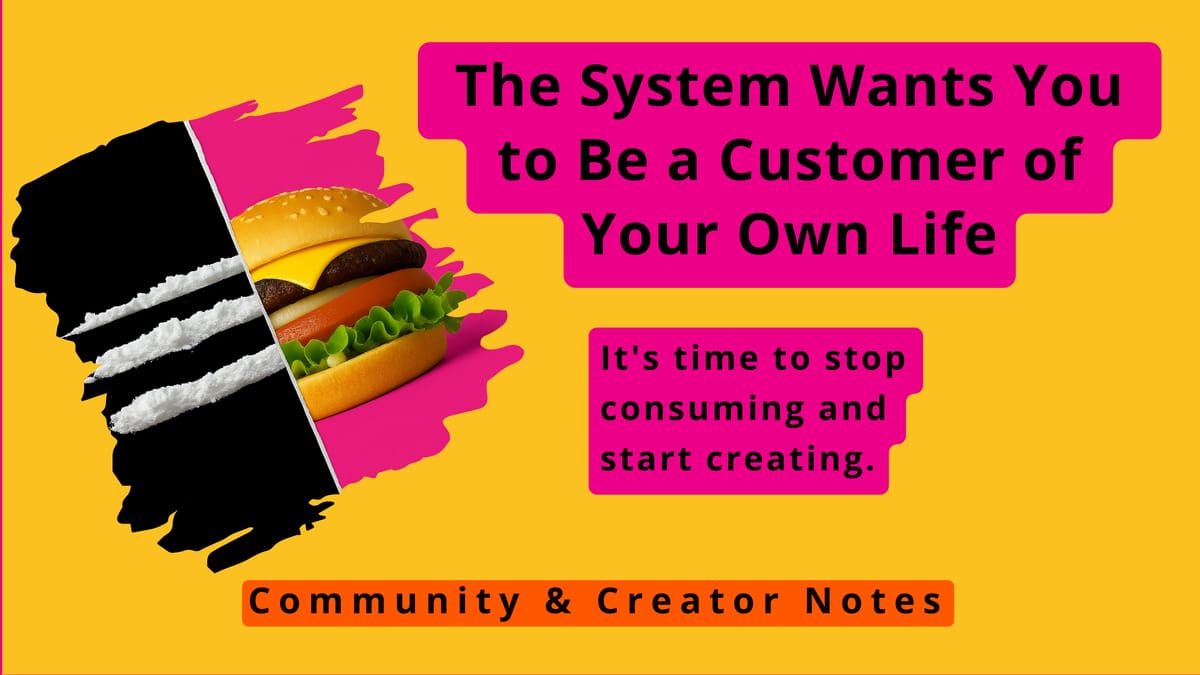
A lab-grade line of cocaine is just one compound—cocaine hydrochloride. But a typical UK fast-food cheeseburger? That’s a chemistry lesson disguised as dinner: citric acid, caramel colour, hydrogenated oils, MSG, cornstarch (yes, cornstarch), emulsifiers, preservatives… and plasticisers like phthalates in up to 80% of them, staining our bodies with 24–40% higher levels after just some fast food.
Now, look at the toll. Last year, 1,118 deaths in England and Wales involved cocaine. That’s tragic. But overweight and obesity-related diseases? They kill over 1.2 million Europeans every year—about 13% of all deaths across the continent.
The absurdity isn’t just a joke. It’s the truth we’ve overlooked, hiding in bun wrappers and neon signs.
And here’s the most cynical part of the model. First, they sell us the shit food that makes us sick. Then, they sell us the "solutions." The healthcare plans, vitamins, supplements, and skincare products. An entire industry built to fix the problems created by another industry.
It’s a perfect, closed-loop extraction.
If you think this is an exaggeration, just look at what happened to the youth-led campaign group Bite Back 2030.
They created an award-winning ad campaign to expose the junk food industry. The prize was public ad space. But when it came time to run the ads, they were rejected. The space continued to be sold to the very fast-food companies they were critiquing.
The system is designed to protect itself.
This is exactly what the extractive mindset has done to our lives. Our experiences, our relationships, and our passions are becoming the human equivalent of ultra-processed food. We’re encouraged to pick the degree that offers the quickest path to a salary, not the one that nourishes our curiosity. We’re told to monetise our hobbies, turning a source of joy into another product to be sold.
Each choice seems quicker, better, more efficient. But the cumulative effect is a life filled with empty calories. A life that looks good on the outside but leaves us feeling spiritually malnourished.
Our Politics Are Processed, Too
This isn't just about food. Our politics are just as processed.
In one room in Westminster, you have Labour leaders Lammy and Starmer talking earnestly about how to "end the violence" in Israel-Palestine. In another, the same government is preparing to sign a £2 billion contract with Elbit Systems—the primary weapons supplier to the Netanyahu regime.
Peace on the podium, procurement in the back office.
We are told stories of peace while the machinery of war is quietly bankrolled behind the curtain. It’s the same model as the food industry: sell a palatable story up front while the toxic ingredients are hidden in the fine print.
What Elizabeth Gilbert Knows About Failure
So what do we do? How do we fight back against a story that’s so pervasive?
There’s a famous self-help question: What would you do if you knew you could not fail?
It’s a Consumer Story question. It frames life as a game to be won.
In her book Big Magic, offers a much better one. A Citizen Story question.
She asks: “What would you do even if you knew that you might very well fail? What do you love doing so much that the words failure and success essentially become irrelevant?”
This question cuts right through the bullshit.
It doesn’t ask about outcomes. It asks about devotion. It asks what you love more than you love your own ego.
This is the only antidote I know to the poison of the extractive mindset. It’s the equivalent of choosing to eat real food.
The writer who fills notebooks that no one sees. The painter who spends a weekend on a canvas that never sells. The coworking community builder who hosts a gathering for three people because those three people needed to be together.
The Consumer Story calls this inefficient. A waste.
The Citizen Story calls this practice. It calls this love. It calls this freedom.
Because when you do something for the love of it, you are no longer a customer of your own life. You are a participant. You are building something that the market can’t measure and, therefore, can’t control.
You are stepping out of the passive story and into the active one. You are reminding yourself that your life is not a business plan. It’s a story you are actively writing.
And the best parts of that story will be the things you did for no good reason at all.
I often discuss this with my fellow writer, podcaster, and all-around creator, Sangeeta.
We both can't function unless we have written something, and when we have written something, another thing pops up and gnaws at us, the world, our life experiences; it has to be written down and worked through.
I know that sounds a little high-brow and romantic, but it is how we cause the friction that instigates conversations and connections. It is easier not to eat and not go to the bathroom for a day than it is not to write or jot something down all day.
I struggle to concentrate with ADHD, but I will go to hell and back to battle with my ADHD to get something written and published - it is a skill I've had to fucking slog at blindly for years.
Bernie's Picks
📚 Book: Manhattan Transfer by John Dos Passos
This book is a punch in the gut from 1925 that feels like it could have been written this morning. It’s not a single story but a chaotic collage of lives in New York City, all scrambling, all chasing something, all getting chewed up by the machine. Dos Passos attacks consumerism and the brutal indifference of city life. It’s a perfect portrait of what happens when a place has a million things to buy but no real soul. It’s the world the Consumer Story builds.
Find out more about Manhattan Transfer here
🛠️ Tool: Kortex.
This is my external brain. It’s an app for capturing ideas, but it’s more than just a note-taker. It’s designed for roaming, for connecting disparate thoughts, for letting ideas collide. The entire theme of today’s newsletter came from me surfacing notes I’d captured in Kortex while walking around Vigo and falling down internet rabbit holes. It’s a tool that helps you see the patterns in your own curiosity, which is exactly the kind of "pointless" exploration we need more of.
🎧 Podcast: How Space4 Coworking in Finsbury Park Creates £2.5 Million In Social Value with Natasha Natarajan.
This conversation is the Citizen Story in action. Hear why a worker-owned cooperative with 70 members matters more than another thousand-desk workspace.
Natasha explains that real community infrastructure isn't about scale or amenities; it's about ownership, shared purpose, and accountability. Space4 is actively building an alternative to the extractive model, proving that when people own their space, they create real value, not just profit. People, this is what's possible!
Do The Work
Last time, I asked you to audit your supply chains. This week, the audit is carried out both internally and externally.
1. The Internal Audit: What is one thing you love doing that you’ve pushed aside because it wasn’t “productive”?
A hobby you dropped. A project you abandoned. A curiosity you didn’t have time for. Pick it back up.
Just for an hour. Don’t ask what the point is. Don’t put it on your to-do list. Do it because you love it. Do it even if you’re bad at it. Do it knowing you might fail. That’s it. That’s the practice.
2. The External Action: Support Bite Back 2030 The young activists at Bite Back 2030 are on the front lines of this fight. The system tried to silence them, so let’s make them louder.
- Get the poster: Download and share their brilliant campaign poster. Put it up in your space. Show your support.
- Follow them on Instagram: Amplify their work. Let them know they’re not alone.
Be a creator, not a consumer.