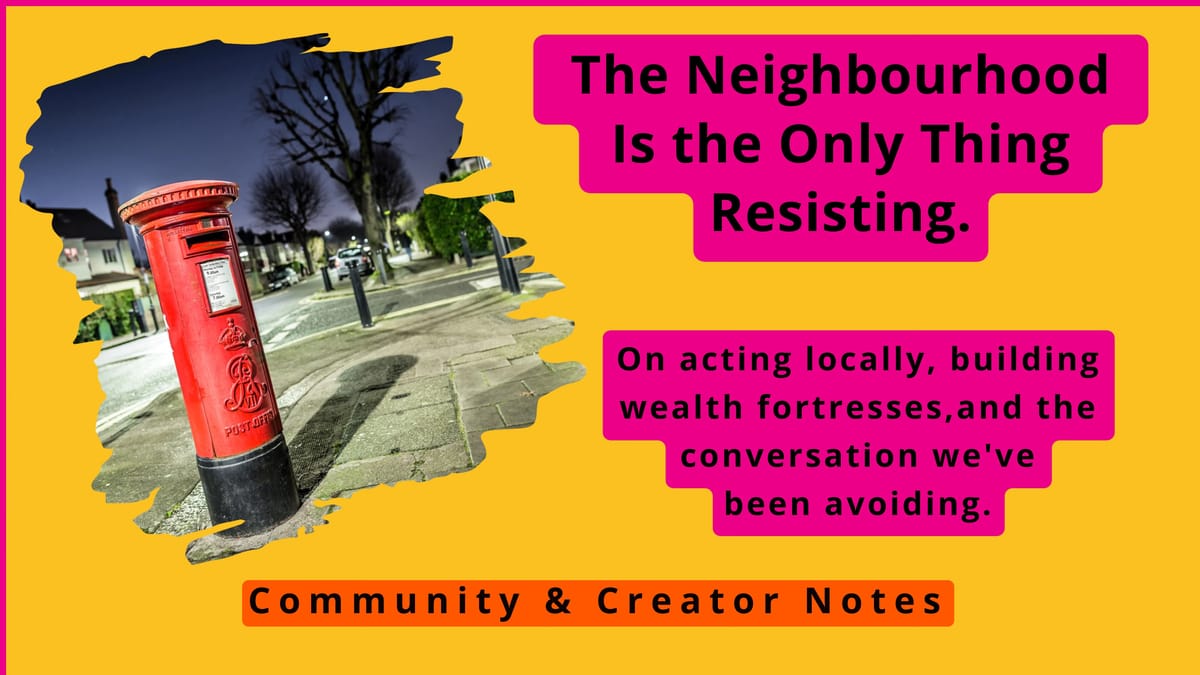
The Neighbourhood Is the Only Thing Resisting
On acting locally, building wealth fortresses, and why February 24th is the conversation we've been avoiding.
Last Wednesday night, a group of people sat in a coworking space in Rochester watching a 25-minute documentary about a woman who stopped doomscrolling and started acting.
Roland Stanley didn’t host this screening to fill desks.
He hosted it because he knows something most people are still figuring out: the neighbourhood is the last line of defence.
The advice is everywhere. But why are we following it?
Right now, everyone’s being told the same thing.
Tell neighbourhood stories. Shine a light on local places. Connect people to the town.
And it’s good advice.
But there’s a question nobody’s asking: Why?
Are we telling neighbourhood stories to market our coworking spaces? To fill desks and boost revenue?
Or are we telling them because the neighbourhood is the only thing currently resisting the corporate hollow-out?
Because those are two very different motivations. And only one of them matters when the economy’s collapsing around us.
Marketing advice vs. survival infrastructure
If you’re telling neighbourhood stories to fill desks, you’re a consumer.
If you’re telling them to build a local wealth fortress, you’re a creator.
Mia Mottley, Prime Minister of Barbados, talks about depopulation, colonialism, and Palestine with an elegance that makes grim realities feel navigable. She doesn’t sugarcoat. She doesn’t despair. She just speaks the truth clearly and moves toward action.
That’s the tone we need when we talk about what’s happening to our neighbourhoods.
Because here’s what’s happening: wealth inequality is the mental health crisis. Work is taxed, not wealth. Big corporations are sucking the life out of local economies. And jobs are thin on the ground.
Gary Stevenson has been saying this for years. The financial stress isn’t a side issue. It’s the issue.
When people talk about the mental health crisis without addressing the economic crisis, they’re missing the point entirely.
The political case for acting locally
Mark Kearney in Canada. Mia Mottley in Barbados. Jon Alexander here in the UK, responding to Mark Carney’s warning about “the rupture.”
They’re all saying the same thing: focus locally.
Robert Putnam’s “Bowling Alone” research—recently revisited with Trevor Noah—makes it clear. If you want to rebuild social capital, you focus on three things:
- Focus locally
- Focus on young people
- Focus on connecting
That’s it. That’s the formula.
And that’s exactly what coworking spaces are built to do—when they’re not busy chasing the corporate playbook.
What acting locally actually looks like
Some spaces talk about amenities and facilities. Gin and tonic. Sun seeker yachts.
Meanwhile, here’s what’s happening in the network:
Roland Stanley at Dragon Coworking in Rochester isn’t just “hosting events.”
He’s screening ACTionism—a documentary about turning climate anxiety into collective action. People showed up. One of them, Rachael Carley, posted about it afterward. That’s proof.
Meanwhile, Ewan Buck at Contingent Works in Bromley hosts Talk Club—a men’s mental health charity that creates space for conversations that save lives. Roland and Ewan know each other. They’re part of the same network doing the same work.
And when the UK government threatened to reclassify coworking spaces and strip Small Business Rate Relief from thousands of small businesses, Roland didn’t just post about it. He secured a meeting with his MP, Lauren Edwards.
That’s the difference between marketing and infrastructure.
Kofi Oppong at Urban MBA in Hackney charges £15 a day for hot desks.
Not because he’s trying to compete with the glass boxes around Old Street. Because his community isn’t the “white middle class with money” (his words) flooding those spaces.
It’s the 57-year-old local entrepreneur learning AI alongside teenagers. The Caribbean grandmothers using Claude AI to write letters to the council. The kids discovering they can create games without needing to know how to code.
That’s what happens when you price for your community, not for your Instagram feed.
Karen Tait at The Residence in Bishop’s Stortford built a space for 150 members.
Every pound circulates locally. Coffee beans from Saffron Walden. Cleaning services, IT support, catering—all sourced within Hertfordshire. Not Amazon. Not a faceless supply chain.
When the business rates crisis hit, she didn’t wait. She met with Josh Dean MP.
Because Karen knows: The Residence isn’t just a business. It’s local economic infrastructure.
Michael Korn at Blue Garage in Lewisham built a maker space with industrial equipment accessible through coworking membership.
Because most hardware inventions die from loneliness, cost, and gatekeeping. Blue Garage is the antidote.
Five minutes from Lewisham Station. Real tools. Real community.
The thread that connects all of this
Tom Ball has been saying it for years: small businesses are the backbone of the local area.
Not the headline-grabbing scale-ups. Not the venture-backed unicorns.
The micro and small businesses—10 sites or less, often just one—that employ people locally, source locally, and reinvest locally.
Jerome Chang runs Blank Spaces—the oldest coworking brand in America—and founded Operators Weekend specifically for people like you. He’s laid out the numbers plainly: after the top three or four brands, everyone’s under four locations.
The majority of operators run one, two, or three spaces.
But all the conversation is about big companies. All the advice is written for people with venture capital and expansion plans.
Meanwhile, the people who actually know their members’ names—the owner-operators with five or less sites—are being told they’re not “real” coworking.
That’s the corporate story. And it’s a lie.
The data says you’re half the market. In London, 51% of coworking spaces are run by micro and small businesses.
You’re not failing. You’re the majority. And you’re the ones building something that lasts.
This is why February 24th matters
The event isn’t about networking. It’s not about “growing your business.”
It’s about connecting the people who are doing this work—micro and small coworking operators who are building civic infrastructure in their neighbourhoods—and talking about what comes next.
Because here’s the reality: you can’t do this alone.
Roland needed Karen. Karen needed Roland. Kofi needed the network. The network needs you.
February 24th is the chance to stop operating in isolation and start operating as a movement.
Not a grand plan. Just one step. The next conversation. The people in the room.
Bernie’s Picks
Watch:
- Mia Mottley + Trevor Noah – How to talk about hard truths with elegance
- Robert Putnam + Trevor Noah on “Bowling Alone” – Why local connection matters
- Mark Kearney’s speech – Leadership calling for local action
Read:
- Jon Alexander’s response to Mark Carney: “The Rupture Is Here”
- Rachael Carley’s post about the ACTionism screening at Dragon Coworking
Follow:
- Roland Stanley (Dragon Coworking) on LinkedIn
- Kofi Oppong (Urban MBA) on LinkedIn
- Karen Tait (The Residence) – doing the quiet work that holds communities together
The Monday Domino
This week, do one thing:
Email one local business in your neighbourhood.
Not to sell them a desk. Not to pitch them membership.
To ask: What’s one thing that would make your week easier?
Then see if your space—or someone in your community—can actually help.
That’s how you build infrastructure. One conversation at a time.
See the gap. Build the bridge.
Thank you for your time and attention today
Bernie 💚🍉
p.s. go deeper with all these stories on the