The Creative Power of Going Dark
What an unexpected blackout taught me about burnout, community resilience, and the hidden cost of constant connectivity.
It's Sunday morning here in Vigo in Galicia, and I've just got my brain back after Monday's massive blackout across the Iberian Peninsula.
I was chatting with my friend Lena on WhatsApp when my phone died mid-sentence.
Instantly, everything around me fell into an unfamiliar silence.
Standing by my office window, I watched as neighbours peered out from their windows, faces puzzled, looking for reassurance or explanation.
Initially, I was annoyed.
I had meticulously planned my Monday: research, writing, deadlines—now impossible without internet or electricity.
But after briefly chasing signals down the street to update my wife's clients, I reluctantly accepted this forced pause.
On Sunday, I read ’s newsletter, in which he wrote about rest as a vital part of the creative process.
I'd been thinking about it for a while, acknowledging that I genuinely needed to slow down, yet I hadn't taken action.
This blackout felt like permission—it was forced upon me, sure, but permission nonetheless.
Constant crises, including the COVID-19 pandemic, geopolitical shifts, and power outages, have marked the last five years.
Even in my quiet life, I'm on constant red alert, which isn't a good way to be.
I don't need to be on 'red alert', but it has become a habit and way of being, and I'm keen to at least move to 'amber' alert this summer.
"If this lasts more than 48 hours, I'll retrain as a blacksmith," I joked with the day after only half laughing.
Conspiracy and community
We wandered outside, searching for lunch and updates, and found our entire street buzzing.
Shopkeepers stood outside their dark stores, sharing speculations and theories that bounced between cyber-attacks, Elon Musk, and Trump, with the latter finally teaming up against us.
A group of elderly ladies with dogs passionately debated international conspiracies as though they'd trained for years with the CIA.
Ironically, most people seemed relaxed amidst the dramatic narratives, even enjoying the absurdity.
At our local bar, patrons joked cheerfully about the apocalypse, drinking beer with urgency, determined to enjoy it cold before the fridges warmed up.
We met one city worker at the supermarket—which had Wi-Fi—because his wife was about to give birth, and it was the only place to get a connection.
I thought he'd tell that story forever—that his baby was born in the blackout.
Sirens and silence
In the afternoon, we climbed the hill at the end of our road, which overlooks Vigo.
The number of emergency sirens surprised me—more than I've heard in three years living here.
It reminded me of our old life in London, where constant sirens blended into everyday noise.
Each siren felt significant here, heightening our sense of an actual emergency.
Yet, oddly, it didn't feel unsafe.
It felt like COVID, where a constraint was placed on everyday life, and people were abruptly pulled out of their regular world, like a sudden pattern interrupt.
There were levels of connection, a tangible sense of 'we're all in this together,' even amidst the uncertainty.
Even as our son returned from school and the children played freely outside, the overwhelming feeling was calm.
And the stars look very different today ⚡️
The night drew us to our friends’ house for dinner, armed with cold meats, cheese, and salads from the supermarket.
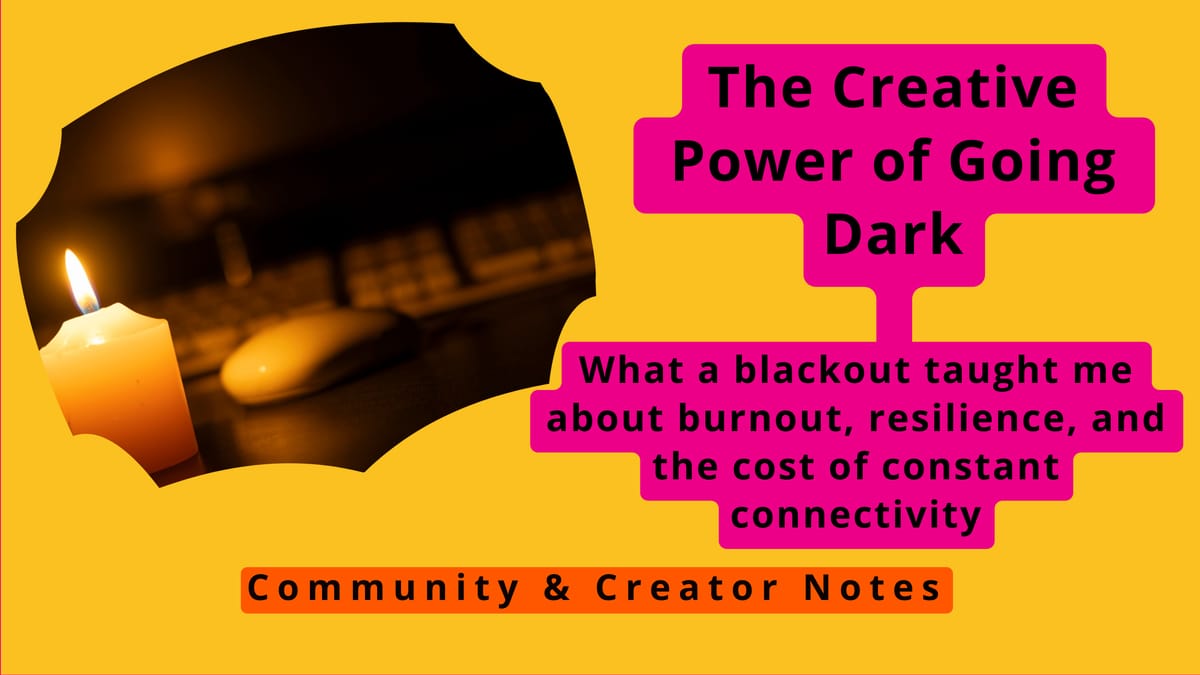
As we ate, darkness gradually swallowed us, lit only by a few candles.
Outside, the usual city lights vanished, replaced by the fading reflection of sunset in silent windows.
We left around 11:30 PM, stepping into a darkness deeper than I've ever experienced in Vigo.
Our street was eerily quiet, reminiscent of early Covid lockdowns—calm, empty, surreal.
Our street was completely dark, making it impossible to navigate without the soft glow of a phone screen.
Looking upwards, past the towering, shadowy apartment blocks, the sky unfolded before us with astonishing clarity.
The stars burst through the darkness, luminous and sharp, like stadium floodlights piercing through an endless void.
Standing there, it felt as though we'd been momentarily transported beyond the mundane, given a brief glimpse of something immense, peaceful, and utterly extraordinary.
And as David Bowie sang, "The stars look very different today."
Loss and Fragility
But the blackout wasn't the day's most unsettling event.
Earlier, we'd discovered José, who ran the café opposite our apartment, had suddenly passed away.
José made the best tortilla in our neighbourhood, and I ate a lot of it.
On busy workdays, my wife and I would go down to José and Beatriz's place and get a gigantic slice of tortilla; even better, some days, he would cook it with chorizo.
Since we moved to Vigo, every birthday dinner I have had has been José's homemade pizza, prepared from scratch, with friends and family at José and Beatriz's home.
In the evening, we encountered Santiago, the waiter from there, on the street; I had noticed him earlier in the day, standing by the café with the shutter half down, but at that moment, I was unaware of José.
Seeing Santiago struggling, I just thought, what a fucking day to have your friend and boss die and then have a massive power cut on top of all that.
What unsettled me most wasn't the power outage but the stark reminder of our genuine fragility—how quickly lives and routines can be irreversibly disrupted.
I spend most of my waking hours thinking about how to justify going downstairs to eat one of José’s Argentine-style empanadas or his tortilla.
Every so often, José would pull me into the kitchen and show me how he made it.
He loved it.
The tortilla was always legendary, but now it is no more.
A forced but welcome pause
Still, I felt a strange gratitude for the blackout.
My life is meticulously online, purposefully location-independent, relentlessly digital.
"All I need is an internet connection!"
Of course, saying, 'All I need is an internet connection' is deceptively simple, like someone centuries ago casually remarking, 'All I need is the ability to start a fire.'
It overlooks the massive infrastructure, technology, and sheer human effort that make something so complex appear effortless.
The Cost of Constant Connectivity
Yet lately, I've recognised how exhausting this constant connectivity has become.
I've made an effort to unplug more, particularly in the evenings, as I recognise how vital it is for mental clarity.
Monday's forced disconnection was oddly convenient—it gave me ‘permission’ to pause, even as anxiety whispered, "What if this doesn't end tomorrow?"
By slowing down all week, I undeniably felt better creatively by Friday.
This experience reminded me that creators don't usually get blackout warnings—we get burnout instead.
It creeps in quietly, disguised as productivity, until we find ourselves creatively exhausted.
Like my blackout day, forced pauses aren't inconveniences but lifelines.
Finding Clarity in Darkness
As we walked home beneath pitch-black skies, the stars were astonishingly clear, sparkling vividly, undiminished by artificial lights.
It struck me profoundly, and I do mean profoundly sometimes: We need darkness to truly see the clarity and beauty around us.
I've spent years crafting my life for ultimate flexibility.
But freedom isn't the Wi-Fi signal or being 'always on.'
Real freedom is knowing when and how to disconnect before life forces you to.
If you're a creator, your real network isn't measured by the number of followers or LinkedIn connections.
It's measured by who you'd turn to when the lights go out, metaphorically or literally.
Who would care if you couldn't show up online tomorrow?
A Challenge for Creators
You can do something real this week: Schedule yourself a blackout.
- Take one day—or even a few hours—to unplug completely.
- Let your mind wander.
- Let yourself recharge.
You will be amazed at the clarity emerging when the screen darkens.
Think back—when this week did someone make you feel truly seen?
Who have you genuinely connected with?
Please leave a note or comment to help others see how to do it.
Let's keep this conversation going with each other.
This article is part of a series leading up to European Coworking Day on 14th May 2025. To register your space or learn more, visit European Coworking Day.
Save time with live coaching and feedback for your event in our online European Coworking Day Set-Up Sprint—Get Your Event Sorted in 1 Hour!
Get our free email course: 5 Biggest Mistakes Coworking Community Builders Make (And How to Avoid Them).
Thanks for your time and attention today!
Bernie 💚