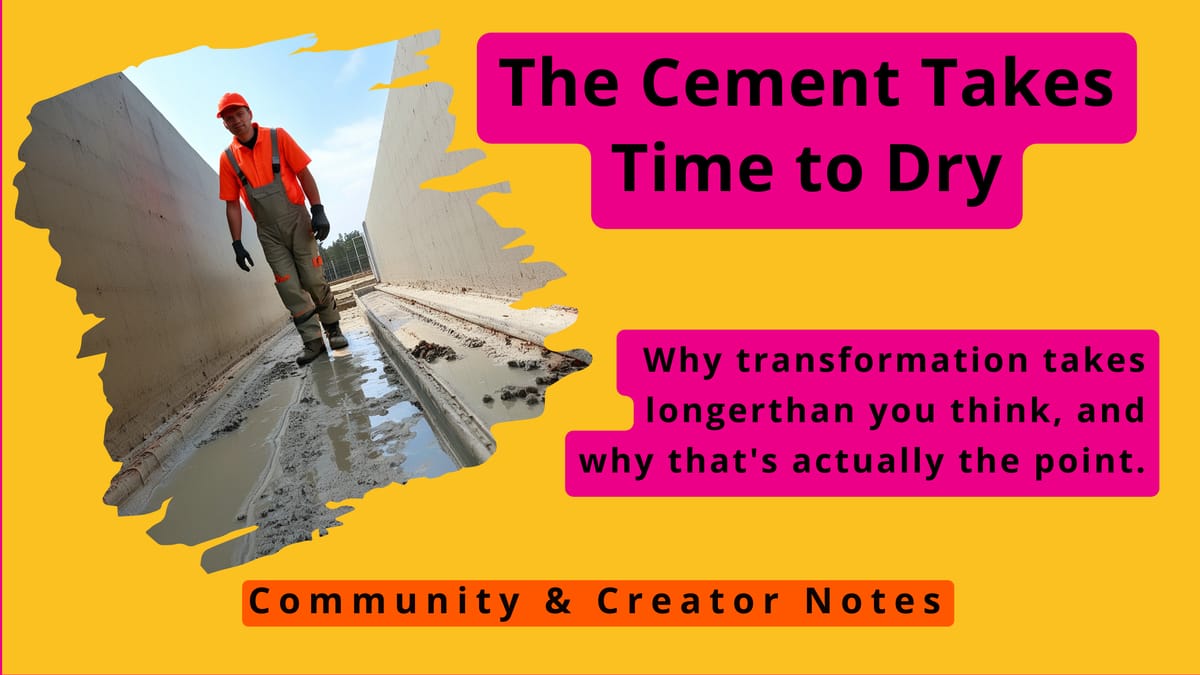
The Cement Takes Time to Dry
Why transformation takes longer than you think, and why that's actually the point
The morning struggle
If anyone talks to me before 9 AM, it throws my entire day.
I know how that sounds. But here's the thing: I need the cement to dry on my intention and concentration for the day.
If someone steps in that cement before it sets, I have to smooth it all out and start again. And the second attempt takes twice as long.
This isn't just ADHD, though it's definitely that. It's about what happens when you're trying to hold focus while processing... everything.
Because I'm not just managing my calendar and inbox. I'm carrying Gaza. Climate collapse. Whether my clients can make payroll. Whether I can.
According to the Metropolitan Police, 532 people were arrested during the policing operation in central London last weekend. The friend who lost their coworking space. The friend who opened their coworking space. The other friend whose mental health is fraying.
I live in a sleepy little town in Galicia, but the world's weight doesn't respect geography.
And here's what I've learned: that fragile morning cement? That's exactly what building real community feels like. Slow. Delicate. Easily disrupted. Nothing like the instant-set concrete the industry keeps selling us.
Twenty years of wet cement
Ashley Proctor and I have been having the same conversation for over a decade, just in different rooms.
When she told me on our recent podcast that coworking "grew out of a movement to care for each other, not an industry plan," I remembered those early days when we were all making it up, hoping the cement would dry before we had to explain what we were building.
"We were solving a problem for peers," Ashley said. Not disrupting an industry. Not scaling a solution. Just trying to hold space for students who'd lost their collaborative workspace during renovations at the Ontario College of Art and Design.
Twenty years later, she's still asking the right questions: "How do you measure the impact on mental health over 20 years? How do you measure the value of dismantling loneliness?"
You can't. Not in quarterly reports. Not in occupancy rates.
"All I can really measure," she told me, "is the scale of the waves we make."
Waves. Not metrics. Not KPIs. Waves that take years to reach shore.
Now, Ashley's working on community land trusts — the logical evolution of the same values. Watching folks come together to lock down affordable housing for generations. Not for the next funding round. For generations.
"Every major problem we're about to face needs to be solved collectively," she said.
But collectively takes time. The cement has to dry.
The price of finding your people
Kofi Oppong just slashed Urban MBA's coworking prices to £15 a day.
After 18 months of trying to compete with the glass boxes around Old Street, he finally understood something crucial: his community wasn't the tech bros flooding the area. It was the 57-year-old local entrepreneur learning AI alongside teenagers.
The Caribbean grandmothers are writing letters to the council. The kids discovered they could create games without needing to know how to code.
"The traditional coworking person," Kofi told me, choosing his words carefully, "is white middle class with money. And they go to all the coworking spaces around Old Street."
But he didn't need to choose his words. I totally fucking agree — and the middle class is slowly being eaten alive by colonial scissors cutting Hackney while landlords lick the blade.
Urban MBA's mission was never about serving the already-served. It was about explaining coworking to people who'd never heard the word. Making it accessible to people who need it most.
Here's the part that made me laugh: Kofi's got VR headsets, 3D printers, quantum computer replicas. The most advanced tech hub in Hackney.
But what brings people in? Word of mouth.
"They don't trust social media," he said. "They want to see that you're doing stuff in the community for them."
Eighteen months to figure that out. Eighteen months of wet cement.
But now? Ali Kakande brings her Cara Eats crew to Urban MBA. Over-50s from the Caribbean diaspora, eating together, learning to use AI to fight bureaucracy. The furthest from the tech are always hit hardest by it — unless someone takes the time to bridge that gap.
"One lady was struggling with the council," Kofi said. "I showed her how to write letters in seconds using AI. These are important skills. It gives them power."
Power. Not profit. Not scale. Power to the people who actually live there.
The six-month miracle nobody saw coming
This time last year, one of my clients was struggling. They're a well-established coworking space, with a good reputation and a strong community.
Then a shiny new competitor opened nearby and undercut every other locally owned coworking space in the area.
What a shitbag move.
Classic Consumer Story bullshit. Disrupt! Scale! Win! Burn the local ecosystem for market share.
My client wanted to panic. Wanted to slash prices. Wanted to add more neon and buy better coffee machines.
Instead, we did some unreasonable connection: we wrote email newsletters. Very specific email newsletters. Every week. For six months. (Before now they were doing one a month.)
Not "Check out our hot desk offer!" emails. Emails that spoke directly to the exact type of person already in their building. Stories about members. Problems being solved. Connections being made. The unglamorous, unsexy work of actual community.
Six months later? They're fully booked. Revenue goals met.
The shiny competitor? Still shiny. Still half-empty. Still a shitbag — so they tell me.
What transformation actually looks like
When we hear the word transformation we think of Thanos snapping his fingers or Wonder Woman spinning around.
When people talk about 'digital transformation,' it sounds like one of the most exciting things that could possibly happen to your company. I used to hear that term and imagine the team from Mission Impossible, or Agents of S.H.I.E.L.D., popping in for the day.
The reality of transformation
I had a front-row seat to actual digital transformation once. Rob, CEO and founder of a financial services company in Clerkenwell, had given me a free office in his building. Just me and my interns in this huge space. I felt like Brian Cox in Succession.
In exchange, I ran events and provided sales training to his staff. Sweet deal. Until Rob moved his entire IT team into MY free office.
FFS! The audacity! How dare these people who actually worked there full-time move into the space I was graciously occupying for nothing! (Actually, sharing with them was brilliant fun, but I'll never admit it.)
This was peak "bring your device to work" era — the iPhone had just dropped, and Rob's 70-odd salespeople refused to make calls without their shiny new toys.
The IT team had to make these iPhones work with a legacy Microsoft system AND a newly launched Microsoft Dynamics CRM that worked with exactly nothing.
Six months. Six months of permissions, protocols, updates, patches, workarounds. Six months of the IT team patiently explaining the same thing to the same salespeople who kept clicking the wrong buttons.
That's transformation. Not sexy. Not Mission Impossible. Just patient people doing boring, essential work until the cement finally dries. (We once ran an event there with Scott, the founder of Meetup — but that's another story.)
Boring consistency is the secret
Most transformations are long and boring.
It's consistent. It's showing up every week with the same message, slightly evolved, until the cement finally dries.
It's like a well-run kitchen in a great restaurant. Every steak hits the grill the same way. Every plate leaves the pass meeting the same standard. The same prep, the same timing, the same attention — every single service. That repetition, that boring consistency, is what creates excellence.
Watch Jiro Dreams of Sushi if you want to see what boring consistency looks like at its apex.
An 85-year-old man who's been making sushi the same way for decades. Same movements. Same standards. Same devotion. Three Michelin stars for doing the same thing over and over until it transcends craft and becomes art.
Consistency builds trust
That's what my client did with their emails. Same message, refined weekly, for six months. Not sexy. Not disruptive. Just showing up at the same time, in the same inbox, with the same commitment to their actual community.
Hand on heart, the more you do it, the better you get at the process, the content, and the ideas. It's like a sport or exercise.
I attended a workshop with Jonathan Stark in 2020, and we were all in awe of his daily email. He explained that he does it so often that he never runs out of ideas. I do a daily email now, and he's totally right.
No quick wins. No growth hacks. Just the slow, patient work of building trust. Just like Jiro's apprentices spending three years learning to cook rice before they're allowed to touch fish.
And here's the thing about weekly emails that I keep emphasising: When you send monthly, people tend to forget who you are.
When you send weekly — even if they don't open every email — you stay top of mind. You're part of their rhythm.
I genuinely care about a newsletter creator. Smart person. Great content. But I forgot to include them in a project listing all my favourite coworking content producers. Why? They publish monthly. Because it only appears once a month instead of weekly, they've disappeared from my mental landscape.
Monthly newsletters are comfortable for you, forgettable for them.
Weekly newsletters are work for you, memorable for them.
Choose accordingly.
Why we're all making it up (and that's the point)
Here's something I want to pay attention to as you read this — Ashley's still asking first principles questions after 20 years: "Are our membership models designed to serve the members first and foremost? Or are they designed to create profit?"
After two decades, she's still keeping the cement wet enough to adapt.
That's the paradox. The Consumer Story wants everything to dry fast — scale it, replicate it, franchise it. But the Citizen Story knows that keeping things slightly unset means you can still make space when your actual community shows up.
Like when Kofi realised he'd been directing his marketing at people who wanted traditional coworking spaces, not his local community.
People (like me) told him that's what he should do — we were on autopilot about how to launch a coworking space rather than paying attention to the audience he actually needed to serve.
Like when Ashley's collaborative student space evolved into community land trusts.
For instance, when my client's emails slowly built a waiting list, their competitor's Instagram ads generated nothing.
Join Us: Unreasonable Connection
Date: August 20, 2025
Time: 14:00-15:00 BST
Topic: "What performative gestures are killing real community in your space?"
Register here: https://lu.ma/lh28lmvv
The people who have signed up this month are among the most active, locally minded, citizen-led coworking spaces and projects on the face of the Earth to ask the uncomfortable question.
No sponsors. No experts selling you solutions.
Just real coworking community builders figuring out the difference between performance and genuine community building.
If you're tired of Instagram-ready spaces where no one talks, "community events" that feel like networking theatre, and "impact metrics" that measure everything except what matters — this is your conversation.
Because here's what Ashley, Kofi and I know after decades in this game: the real work happens when the cameras are off, the cement is still wet, and we're honest about what's not working.
The collaboration over competition
Here's something you might not know: a group of independent coworking podcasters — me, Emily, Fanny, Navarro, Caleb and Suzanne — are now deliberately posting our episodes in the mighty LinkedIn group.
(Fun fact: the LinkedIn Coworking Group was founded by the inventor of the #hashtag, Chris Messina!)
We could have built our own little kingdoms. Could have hoarded our audiences.
Instead, we're all posting in the same place, trying to breathe life back into actual conversation.
It's like an early 90s warehouse party — before the accountants moved in, before Ministry of Sound became a brand.
That's the Citizen Story in action. Not "building an audience" but "finding the others" and building a scene.
Join us. The conversation needs your voice.
Your move (yes, still your move)
The cement is still wet. It's always wet.
That's not a bug — it's the feature.
The Citizen Story isn't about building perfect structures. It's about keeping the cement wet enough that when your actual community shows up — the 57-year-old entrepreneur, the Caribbean grandmother fighting the council, the artist who needs a £15 desk — you can still make space for their footprints.
So here's my question: What's your cement? What in your work needs time to dry?
What transformation are you rushing that actually needs six months of boring consistency?
And more importantly: Are you brave enough to admit that the quick fix you're selling might be the very thing preventing real community from forming?
The coworking industry promises instant community, frictionless connections, and scalable belonging. But you and I both know: the real work takes time.
The cement takes time to dry.
And maybe — just maybe — that's exactly how it should be.
Bernie's Picks
🛠️ Tool: Sunsama.
A few weeks ago, I went back to Sunsama, because it helps me track time in my calendar, has a super place for backlog capture, and a daily shutdown journal. I'm happy to pay their eyewateringly huge subscription to keep my shit together every day.
A lot of what I do is very predictable: research, write, podcast, and have calls about how to apply all that stuff with people. I now have three blocks:
1. Revenue, 2. Publishing, 3. Deep creation — and these follow my energy.
Everything is organised and tracked in Sunsama. The cement of my day dries because Sunsama holds the structure while my ADHD brain gets to work.
📚 Book: Doppelganger: A Trip into the Mirror World by Naomi Klein
I picked this up after hearing Klein speak about Zionism as a trauma response — how historic wounds can harden into identity politics that, instead of healing, become weapons of exclusion. What struck me most is that Klein writes this as a Jewish thinker herself, wrestling with the mirror worlds of identity, nationalism, and projection.
This isn't a book about "over there." It's about how trauma, fear, and doublespeak distort communities everywhere — coworking included — into reflections of the very forces we claim to resist. If last week we traced how consumer comfort launders complicity, Doppelganger shows how easily our stories of liberation can be turned against us unless we stay alert.
🎙️ Podcast: Building Coworking for the People Who Actually Living in Hackney
This week's Coworking Values episode with Kofi Oppong is a must-listen.
Urban MBA has reduced its prices to £15 a day because it finally realised its real community isn't the tech bros flooding Old Street — it's the 57-year-old local entrepreneur learning AI alongside teenagers, the Caribbean grandmothers writing letters to the council.
Thank you for your time and attention today
Bernie 💚🍉
p.s. - Listen and read with us twice a week on the Coworking Values Podcast