Can you explain your business with a piece of cardboard?
“You can’t fake the work.”
So Reader,
One of my favourite days is when I’m taking the train from Vigo to Viana do Castelo. No car. Just the Renfe line hugging the Galician coast before crossing the border into Portugal.
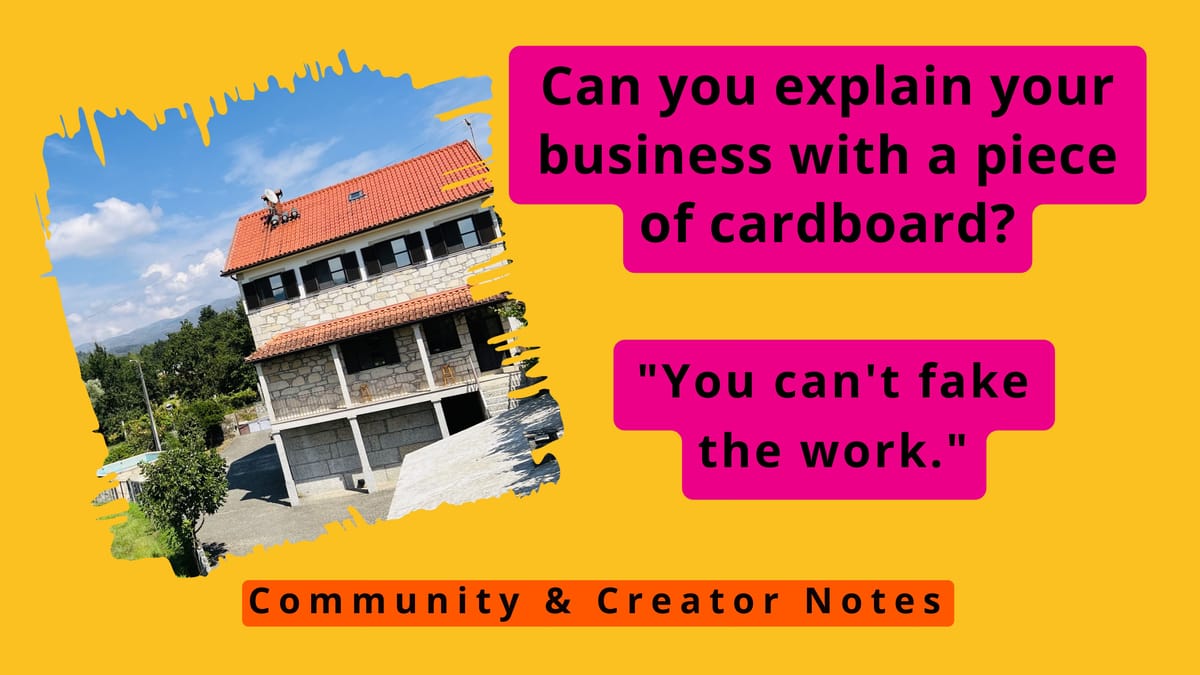
In Arcos de Valdevez, Maria do Ceu Bastos has built something she named Nowhere Desk. It is a coworking and coliving space with a garden you can get lost in. Near rivers, you can swim in. A village that slows your pulse the moment you arrive.
I have known Maria for five years. She is a freelance translator by trade. An independent economic agent building a community while making her own living.
For years, she talked about this project. Then in November 2023, after lunch with Joana Carvalho at DINAMO10, Claire Carpenter, Thilo Utke and I went with Maria to see the building she had just bought. It was still raw. Walls needed work. The garden was overgrown. But you could see what it would become.
She has been ‘building’ it since 2023. Now it is real, it’s alive and kicking.
Last week, Maria posted from a workshop at the ‘legendary’ Sende, a rural innovation hub here in Galicia. The workshop was called “Low-tech communication from the village.“
(Read Juan Barbed‘s post on the ROORAL blog about the workshop with Edo Sadiković Click here.)
And this line in her post has been burning a hole in my brain ever since.
“If you can explain your work with cardboard, a marker and a phone, you probably understand it.”
I love this sentiment, as I see more and more people get jacked up about AI and fall on their face; it’s because they’re asking it to do something they don’t understand themselves.
The tools are a distraction
We spend half our lives hiding behind software. We obsess over open rates and algorithm changes. We convince ourselves that if we just find the right app, the sheer effort of building something will get lighter.
That is the Consumer Story talking. It tells you that the solution to your isolation is a product you can buy.
But Maria is right. The real work—the Citizen Story work—is messy, human, and low-tech. It is about showing up and saying, “I am here. I am making this.”
I stopped chasing streaks
I have been thinking about this all year.
I stopped using Duolingo after nearly 2,000 days. Not because I had learned Spanish. I had not. I was chasing the streak, not the learning. The tool had become the point.
Here in Vigo in Galicia, where I live, I’d walk around every day talking to my phone and Duolingo, when I could be talking Spanish to a human being.
Back in December, I asked Ewan Buck at Contingent Works what he got out of Talk Club. He said, “I stopped using Instagram.”
I've wanted to do this for ages. So I hardly posted over December, and decided to quit this year. I posted on every platform last month: find me on LinkedIn, Substack, and YouTube.
That is it. I have got my life back. I can sit down in a restaurant and not take a picture of my food.
I have been severely slowing my social media in 2025, my mind fractured by the scroll, going in 12 different directions.
I still have to create. YouTube videos. This newsletter. Then I post those to LinkedIn. But I am more interested in making and thinking out loud than I am in hiding behind the tools.
I’ve told this story before
If you are a regular reader, you know the McKenzie lad. He appears in these notes every so often. He is almost a recurring character now.
But I need to tell it again. Because this is where everything started.
Summer 2019. I was at Mainyard Studios in Hackney, standing in front of a group of young people from Urban MBA. Feeling pleased with myself.
I started vomiting jargon. “Synergy.” “Ideation.” “Ecosystems.”
At one point, a 17-year-old in a McKenzie hoodie with the hood up shouted from the back:
“Oi, mate, what the f*ck is coworking?”
I said something like: “It’s all about the ‘co’—it’s the interdependency of collaboration, community at an intersection of re-imagining society.”
And he said, “Why don’t you just call it work?”
The room went silent.
He was right. I was hiding behind language. Using words to exclude the very people we claimed to be serving. I could not explain it with a cardboard and a marker. I needed buzzwords to feel important.
That moment started something. It was the beginning of what has become the London Coworking Assembly‘s work with Urban MBA.
I wrote about what happened next in a recent newsletter for the London Coworking Assembly.
- How Hannah Philp hosted Urban MBA at ARC Club Homerton for a 12-week course in 2021
- How Caleb Parker hosted Urban MBA for their groundbreaking first 12-week course at XCHG Spaces in 22 Bishopsgate in 2022.
- How Charlie Harris from The Workers’ League made the connection that got Urban MBA their own space in Wenlock Street near Old Street roundabout.
- How Fiona Ross helped get the Ministry of Sound to host the Urban MBA Fashion Week show, which changed everything!
- How Edward Crabtree and Jon Seal at technologywithin sorted the Urban MBA wifi, IT and coworking space software when they moved into Wenlock Street.
The Coworking Assembly participants didn’t just talk about supporting them; they acted. It helped them build their network connection by connection over five years.
Which is why, on February 24th at Blue Garage in Lewisham, Urban MBA is running the floor at our gathering.
Blaze and the current cohort are handling logistics. One of the epic Urban MBA food start-ups is doing the food. Their media team is running the podcast studio at the event.
We’ve designed the day using the work of Adrian Segar and Peter Block to ensure a lasting “unreasonable connection” among participants.
We are handing the keys to the next generation. Answering the McKenzie lad’s question.
The Cardboard Test in Action
Low-tech forces clarity. It’s more human: slower, imperfect, grounded in real presence. Here are five ways people in our network are building civic infrastructure right now, from the simplest conversation to a continent-wide movement.
Way 1: Start a Talk Club
Stop guessing how people are feeling. Talk Club is a talking and listening club for men. Forget complex onboarding or a mandatory app—the heart of it is just a time, a space, and a simple format that lets people say what they are actually experiencing.
It looks like blokes having a conversation. That’s the whole thing. Ewan from Contingent Works, whom I mentioned earlier, hosts one in his coworking space. He’ll be at our gathering on the 24th Feb, ask him how it’s changed his community. Talk Club Website.
Way 2: Host an ACTionism Screening
Jon Alexander’s work on the “Citizen Story” is the backbone of what we do. Hosting an ACTionism documentary screening is a wonderful way to spark a conversation about ownership and agency with people from your local area. You do not need a cinema. You need a wall, a screen, and chairs. Maybe some drinks.
The film does the work. Urban MBA showed it. Village halls are showing it. Coworking spaces like Patch and Dragon Coworking are showing it. It starts a conversation you cannot fake. Request a screening.
Way 3: Run a Creator Write Club
For a decade, we ran these across London, sometimes in multiple spaces a week. Around a single table, you’d find a journalist next to a poet, a musician next to a sailor. The ritual was always the same: state your intention, write in focused silence for two hours, then share what you made.
It’s a tiny, powerful act against loneliness—a space to work alone, together. It works anywhere from a village hall to a Zone 1 cafe, and all it costs is a table and the willingness to show up.
Way 4: Host a Pop-Up Coworking Event
You don’t need a permanent building to create a community hub. I’ve run pop-up coworking events for years—in London backrooms, rural cafes, and now, right here in Galicia with my LiveGalicia crew and Galipreneur Connect.
Our spot is La Contenedora, itself a coworking space within a vibrant textile and design hub. You walk through the coffee bar, and upstairs, painters stand at their easels while our group works on laptops. I LOVE IT! It’s a perfect, chaotic mashup of creation and work, and it’s a five-minute walk from my front door. 👍
Way 5: Join the European Coworking Day Movement
Think of this as the day all the other ways come together.
May 6th is European Coworking Day. It’s a powerful, people-powered movement run by our friends at Coworking Switzerland as part of the wider European Coworking Assembly a network that includes London Coworking Assembly, Coworking Values Podcast and European Rural Coworking Project.
This very collaboration is our collective antidote to corporate coworking. It’s the moment for the independent spaces—the heart and soul of this industry—to be seen and counted. This isn’t about a one-off party. It’s about showing your neighbours the real, human-scale economic engine you’re running and forging the local connections that build real community.
Whether you’re in a village in Galicia or a neighbourhood in London, this is your platform. You don’t need a huge budget. A Talk Club, a pop-up, an open door—any of the ways listed above can be your contribution. The goal is simple: put yourself on the map and say, “We’re here.”
Register your space today: European Coworking Day.
February 24th at BLUE GARAGE 💙
If you are looking for your crew—the people actually building this, quietly, in their neighbourhoods—we are gathering in Lewisham BLUE GARAGE 💙
It is called Unreasonable Connection Live - The London Coworking Assembly Forum.
It’s not a conference; it is an all-day intentional time to connect and talk with fellow space owners and operators, particularly around local connections and local economic development.
- No keynotes.
- No panels.
- No stages.
Who is this for?
The Independent Operator: You’re in the trenches. You’re unclogging toilets AND doing the P&L. You want validation that your struggle is systemic, not personal failure.
The Community Manager: You’re the emotional safety net for your members, but no one’s supporting you. You’re at risk of burnout, and you need strategies that actually work.
The Local Authority: You have a budget to “save the high street,” but the traditional methods aren’t working. You need real partners who are actually in the buildings, doing the work.
If you need to find the others, that is where we will be.
Thank you for your time and attention
Bernie 💚🍉
P.S. Every time you obsess over an open rate, you’re working for the software company. Every time you clarify your message on a piece of cardboard, you’re working for your community. Choose who you work for.